Showing posts with label Resistor. Show all posts

Tuesday, 10 June 2025

Complete Guide to Amplitude Modulation (AM)

Amplitude Modulation Explained

Amplitude Modulation (AM) is among the earliest and most fundamental methods in wireless communication. It set the stage for long-distance audio broadcasting, taking the place of previous spark-gap transmitters. Whether you are an electronics student or a hobbyist dealing with RF circuits, grasping the principles of AM, both in theory and practice, is crucial. This tutorial will guide you through the concepts of AM, waveforms, circuit design, and testing it using an oscilloscope.

What is Modulation?

Modulation is the process of adding a low-frequency message signal, like audio, to a high-frequency carrier signal. This allows the signal to travel longer distances more efficiently. There are three primary types of analog modulation:

Oscilloscope Screen Carrier Wave and Amplitude Modulated Wave

Materials Required

  1. BC547 - 1 
  2. 7805 - 1 
  3. Resistor - 470Ω - 3
  4. Resistor - 100Ω - 1
  5. Resistor 1KΩ - 1
  6. Capacitor - 470nF-2
  7. Capacitor - 10pF-1

AM Part Markings

Amplitude Modulation may be one of the earliest modulation techniques, but its simplicity, educational value, and real-world relevance make it worth exploring. Whether you're preparing for exams, building wireless audio projects, or diving into RF basics, understanding AM is a key milestone in your electronics journey.

Monday, 3 June 2024

Calculating the Right Resistor for Your LED: A Step-by-Step Guide

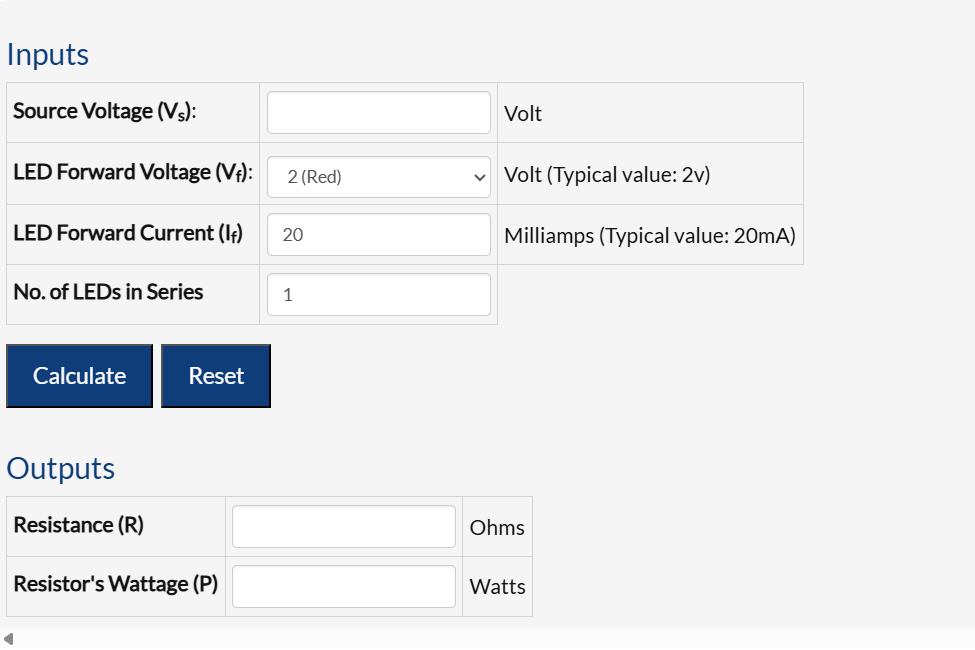
Using an LED resistor calculator can help you determine the appropriate resistance for your LED circuit, ensuring your LEDs operate safely. Here's how to use one effectively.


Inputs

  • Source Voltage (Vs): The total voltage from your power source, measured in volts.

  • LED Forward Voltage (Vf): The voltage drop across the LED, which varies by color (e.g., Red = 2V).

  • LED Forward Current (If): The current flowing through the LED, typically around 20mA.

  • Number of LEDs in Series: How many LEDs are connected in a series configuration.


Outputs

  • Resistance (R): The value of the resistor needed, measured in ohms.

  • Resistor's Wattage (P): The power rating of the resistor, measured in watts.


Why Use a Resistor with LEDs?

LEDs require a specific range of current to operate correctly. Exceeding this range can damage the LED. A resistor in series with the LED helps limit the current to a safe level.


How to Use the Calculator

Input Values: Enter the source voltage (Vs), LED forward voltage (Vf), LED forward current (If), and the number of LEDs in series.

Calculate: The calculator will provide the necessary resistor value (R) and its power rating (P).

LED Forward Voltage by Color

Red: 2V

Green: 2.1V

Blue/White: 3.6V

Yellow: 2.1V

Orange: 2.2V

Amber: 2.1V

Infrared: 1.7V


Calculation Equation

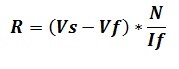
To find the resistor value mathematically, use the equation:


LED resistor calculation

​Where:

Vs: Source voltage

Vf: LED forward voltage

If: LED forward current (in amps)

N: Number of LEDs in series


Using an LED resistor calculator simplifies finding the right resistor to ensure your LEDs work safely and efficiently. By inputting your circuit parameters, you can quickly get the necessary resistance value and avoid potential damage to your LEDs.


To use the calculator, visit: LED Resistor Calculator.