The human nose can detect about 1 trillion different odors, but identifying specific gas types or concentrations in the atmosphere requires specialized sensors. Gas sensors are essential for detecting toxic gasses to maintain safety and prevent hazards. These sensors are used to detect gasses like oxygen, carbon dioxide, nitrogen, and methane, commonly found in air quality monitoring devices and gas leak detectors.
What is a Gas Sensor?
A gas sensor detects the presence or concentration of gasses in the atmosphere. It produces a corresponding potential difference by changing the resistance of the material inside the sensor, measured as output voltage. This voltage helps estimate the type and concentration of the gas.
Types of Gas Sensors
1. Semiconductor / Metal Oxide-Based Gas Sensors:
Detect changes in resistance of a semiconductor material (e.g., tin dioxide) when exposed to gases. These sensors are sensitive and inexpensive but require regular calibration and are affected by temperature and humidity.
2. Electrochemical Gas Sensors:
Measure gas concentrations through oxidation or reduction at an electrode, generating a current proportional to the gas concentration. They are accurate and specific but can be poisoned by other gases and have a limited lifespan.
3. Non-Dispersive Infrared (NDIR) Gas Sensors:
Measure gas concentration based on infrared absorption. They are highly accurate and durable but more expensive and limited to detecting gases that absorb infrared light.
4. Catalytic Gas Sensors:
Use a catalytic bead that changes resistance when it oxidizes flammable gases. They are effective at low gas concentrations but require oxygen and can be poisoned by certain chemicals.
5. Photoionisation Detectors (PIDs):
Use UV light to ionize gases, measuring the current generated by these ions. They are sensitive to volatile organic compounds but have high lamp replacement costs and environmental sensitivity.
6. Thermal Conductivity Gas Sensors:
Assess changes in thermal conductivity caused by different gases. They are simple and durable but have lower sensitivity and are influenced by ambient temperature.
7. Gas Chromatograph Analyzers:
Separate and measure components of a gas mixture. They are highly accurate but expensive and require skilled operation.
8. Capacitance-Based Gas Sensors:
Detect changes in capacitance due to gas absorption on the sensor's coating. They are sensitive to humidity but require careful calibration.
9. Acoustic-Based Gas Sensors:
Measure changes in acoustic properties caused by gas presence. They are quick and non-invasive but require frequent calibration.
10. Calorimetric Gas Sensors:
Measure heat change from a chemical reaction with the target gas. They are specific but generally slower in response.
11. Magnetic Gas Sensors:
Leverage magnetic properties of certain gasses to gauge concentration. They are stable and unaffected by interference gasses but limited to paramagnetic gasses.
Semiconductor / Metal Oxide-Based Gas Sensor Construction
These sensors consist of:
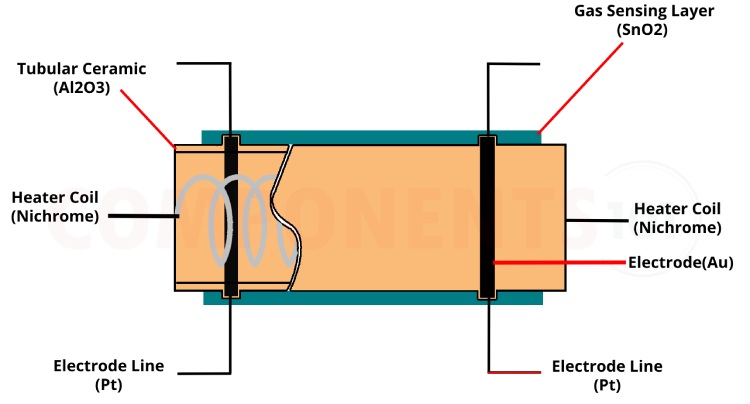
Gas Sensing Layer: Detects gas concentration changes.
Heater Coil: Preheats the sensing element for increased sensitivity.
Electrode Line: Conducts small currents generated by the sensing layer.
Electrode: Connects the sensing layer to the electrode line.
Tubular Ceramic: Maintains preheating of the sensing layer.
Mesh: Protects the sensing elements from dust and corrosive particles.
Working Principle
These sensors use a chemiresistor, typically Tin Dioxide (SnO2), an n-type semiconductor. In clean air, oxygen attracts free electrons from SnO2, preventing current flow. When exposed to combustible gasses, these gasses react with the adsorbed oxygen, freeing the electrons and allowing current to flow, proportional to the gas concentration.
Using a Gas Sensor
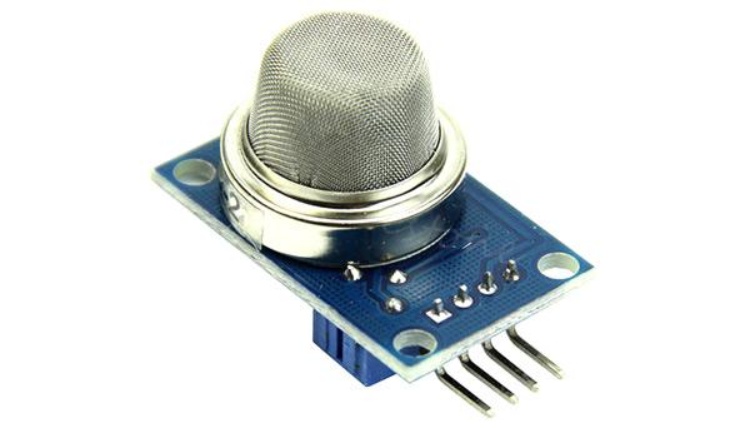
A typical gas sensor has six terminals: four for input/output (A, A, B, B) and two for the heater coil (H, H). Modules often include additional components like a comparator (LM393) and an adjustable potentiometer for setting the gas concentration threshold. The module has four pins: Vcc (power supply), GND (ground), Digital output (high/low signal), and Analog output (continuous voltage signal).
Popular Gas Sensors
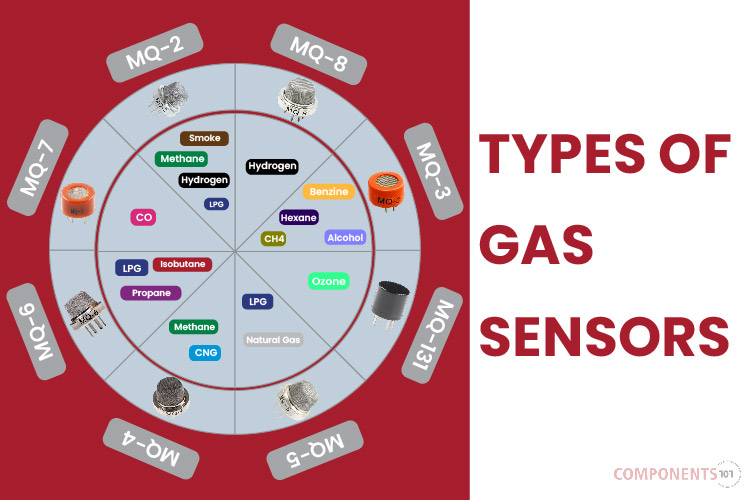
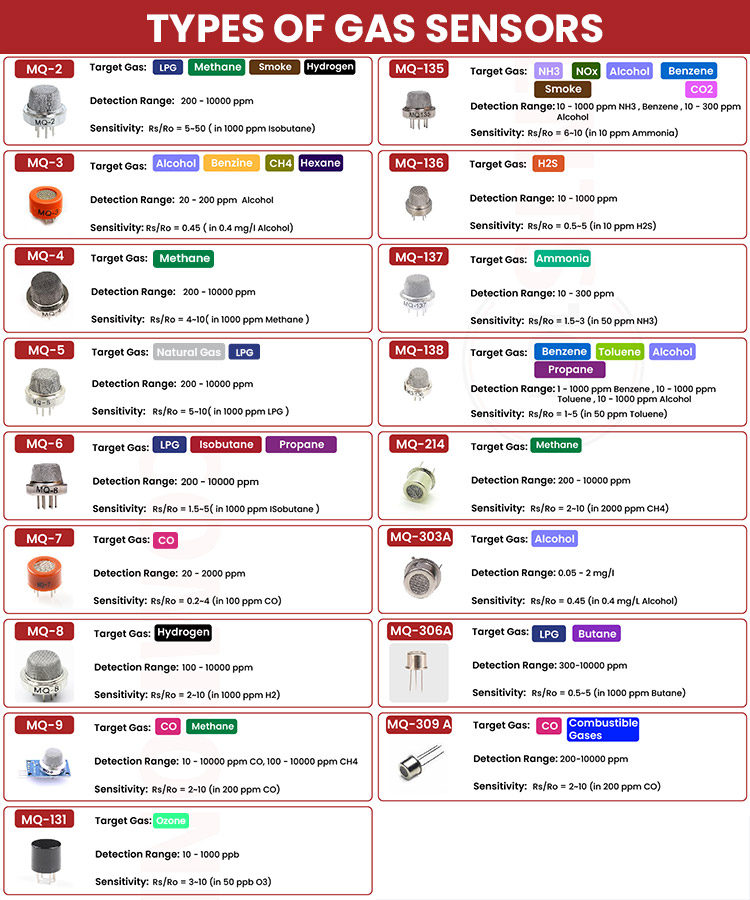
Popular semiconductor gas sensors include MQ-2, MQ-3, MQ-4, MQ-5, MQ-6, MQ-7, MQ-8, MQ-9, MQ-131, MQ-135, and MQ-136. These sensors are widely used for their reliability and sensitivity.
Applications
Industrial Monitoring: Detecting toxic gas concentrations.
Household Safety: Detecting gas leaks.
Oil Rigs: Monitoring released gases.
Hotels: Preventing smoking in non-smoking areas.
Offices: Monitoring air quality.
Air Conditioners: Checking CO2 levels.
Fire Detection: Identifying combustible gases.
Mining: Ensuring miner safety.
Breath Analyzers: Measuring alcohol content.
Gas sensors are crucial for safety and air quality monitoring across various environments. Understanding their types, construction, and working principles helps in choosing the right sensor for specific applications.


