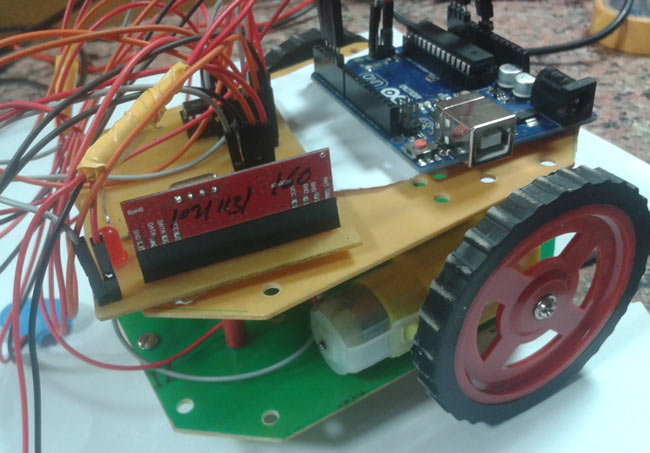
Gesture control is quickly becoming a natural way to interact with machines. Instead of relying on buttons or joysticks, this project lets you control a robot using simple hand movements. By combining computer vision with wireless communication, this system creates a responsive and intuitive control experience.
This Hand Gesture Control Robot Using OpenCV project demonstrates a hand gesture control robot using OpenCV, where a laptop webcam detects hand movements and translates them into motion commands for a rover.
How the System Works
At its core, the system follows a three-stage process: gesture detection, wireless transmission, and motor execution.
A Python program running on a laptop captures live video through a webcam. Using OpenCV and MediaPipe, it detects 21 key points on the hand and determines which fingers are raised. Based on this pattern, the system identifies gestures like forward, backward, left, right, or stop.
Once a gesture is recognized, the program sends a simple command (like “F” or “L”) via serial communication to an Arduino Nano acting as a transmitter. This Arduino then forwards the command wirelessly using the nRF24L01 module.
On the robot side, another Arduino Nano receives the command and controls the motors through an L298N Motor Driver, allowing the rover to move accordingly.
Key Components

The setup uses easily available components, making it accessible for students and hobbyists:
- Two Arduino Nano boards
- Two nRF24L01 wireless modules
- L298N motor driver
- 4-wheel DC motor chassis
- Laptop with webcam
- 12V battery pack
Each component plays a specific role, from gesture processing to wireless communication and motor control.
Gesture Recognition with OpenCV
The vision system is powered by OpenCV and MediaPipe. OpenCV handles camera input and frame processing, while MediaPipe detects hand landmarks in real time.
The system identifies finger positions and converts them into commands:
- Index finger → Forward
- Two fingers → Backward
- Thumb + index → Left
- Three fingers → Right
- Open hand or fist → Stop
This logic keeps the system simple while ensuring accurate gesture detection.
Wireless Communication

The nRF24L01 modules enable low-latency wireless communication between the controller and the robot. Commands are transmitted as single characters, keeping the data lightweight and fast.
With proper configuration, the system achieves reliable communication within a short range, making the robot feel responsive and smooth during operation.
Robot Movement and Control
On receiving a command, the rover executes it instantly. The L298N motor driver controls the direction and speed of the motors using PWM signals.
For safety and stability, the system limits motor speed to around 50%, ensuring controlled movement without overloading the hardware.
Real-World Applications
This project goes beyond just a demo and opens doors to practical applications:
- Contactless robotic control systems
- Assistive technology for accessibility
- Surveillance and remote-controlled vehicles
- Educational platforms for robotics and AI
- Human-machine interaction research
This hand gesture control robot combines computer vision, wireless communication, and embedded systems into a single project. It offers a hands-on way to understand how modern interfaces work and how machines can respond to natural human input.
With its simple design and powerful concept, this project is a great starting point for building advanced gesture-controlled systems and exploring real-time robotics.
Robotics Projects |Arduino Projects | Raspberry Pi Projects|
ESP32 Projects | AI Projects | IoT Projects | Drone projects | Electronic Circuits | Electronics Projects